

Study in China
2026 Guide
Perfect for
International Students
Complete Guide to the China Scholastic Competency Assessment
Planning to study in China? This comprehensive guide helps international students understand the CSCA examination, including eligibility, syllabus, registration, scoring, preparation strategies, and university admissions. Whether you're applying through scholarships or direct university admission, this guide provides everything you need to begin your journey with confidence. The CSCA is a relatively new examination, so requirements may evolve over time. Always verify the latest information with the official CSCA website before registering.
Before You Begin
Please read the following information before using this CSCA preparation guide.
About this Guide
This is an unofficial guide created to help international students understand the China Scholastic Competency Assessment (CSCA) and prepare confidently for the examination. It explains the structure of the test, important information, preparation strategies, and what students can expect before applying to universities in China.
Disclaimer
The CSCA is a newly introduced examination, and information regarding its format, eligibility, registration process, and schedule may change as new updates are released.
This guide represents our best research and understanding of the current examination landscape. While every effort has been made to ensure accuracy, students should always verify the latest announcements, dates, and official requirements through the official CSCA website before registering for the exam.
Feedback from students is always welcome. If you notice any updated information or changes, please let us know so this guide can remain accurate and helpful for future applicants.
Copyright Notice
This guide has been prepared as an educational resource for students interested in studying in China. The content is intended solely for informational purposes.
No part of this publication may be reproduced, distributed, stored, or transmitted in any form or by any electronic, mechanical, photocopying, recording, or other means without prior written permission from the respective copyright owner.
What is the CSCA?
Understanding the CSCA Exam

Undergraduate
Entrance Test
For Students
Worldwide
What is the CSCA?
The China Scholastic Competency Assessment (CSCA) is an entrance test for international undergraduates, created to give Chinese universities a common benchmark for judging whether applicants are ready for degree study.
The test is developed and administered under the China Scholarship Council (CSC).
Important Update
Beginning with the 2026 intake, the CSCA score report (transcript) becomes a mandatory document for undergraduate applications to Chinese Government Scholarship universities.
How the Admission Process Changed
The introduction of the CSCA solved one of the biggest challenges international students and Chinese universities faced.
Before CSCA
Admission Challenges
For a long time, getting into Chinese universities as an international student was confusing and inconsistent.
The main challenge was that students came from different countries with different education systems and curriculums.
This made it extremely difficult for Chinese universities to fairly compare applicants' academic abilities, especially in subjects like mathematics where curriculum rigor and grading standards varied dramatically between countries.
A student with 90% in math from one country might have a completely different skill level than a student with 90% from another country.
There was no standardized way to assess whether international students had the foundational knowledge needed for Chinese university programs.
What CSCA Does
A Standardized System
The CSCA completely changes this.
It creates one clear, standardized test that all universities recognize and trust.
For international students, this is a game-changer: you finally know exactly what you need to prepare for, how you'll be evaluated, and what schools are looking for.
Official Definition
What Is It?
According to the China Scholarship Council (CSC), the CSCA is a fair and scientific test that measures whether you're ready for university-level study.
Think of it as China's way of making international admissions as structured and rigorous as the gaokao (the national college entrance exam for Chinese students) but designed to work for students from any educational background around the world.
Guide to the CSCA Exam
Students must take the CSCA exam before applying for CSC scholarships or universities that require these results for admission.
Important CSCA Timeline
Keep track of the important milestones and official deadlines.
First Global Exam
December 21, 2025
2026 Schedule
5 sessions annually (January, March, April, June, December)
By 2028
Expected to be mandatory for ALL undergraduate applicants
Registration Deadline
First Exam Session
November 25, 2025 (for the December 21, 2025 exam session). Check the other deadline for other exam session on the official website (csca.cn)
Official Website
Learn More
Why the CSCA Matters
The CSCA replaces the old document-based admission system with a transparent, standardized evaluation comparable to China's gaokao (for domestic students) or SAT/A-Levels internationally.
Fair Evaluation
Fair evaluation across diverse educational systems
Academic Readiness
Unified standards for academic readiness
Scholarships & Admissions
Merit-based selection for scholarships and admissions
A Transparent Admission Process
The CSCA replaces the old document-based admission system with a transparent, standardized evaluation comparable to China's gaokao (for domestic students) or SAT/A-Levels internationally.
Fair evaluation across diverse educational systems
Unified standards for academic readiness
Merit-based selection for scholarships and admissions
Exam Structure & Subject Requirements
The exam consists of 5 subjects. You do not necessarily take all of them; your selection depends on your major.
| Subject | Time | Questions | Language | Who Needs It? |
|---|---|---|---|---|
Mathematics | 60 min | 48 Multiple Choice | English or Chinese | MANDATORY for all applicants. |
Physics | 60 min | 48 Multiple Choice | English or Chinese | Required for Engineering, Computer Science, and Physical Sciences programs. |
Chemistry | 60 min | 48 Multiple Choice | English or Chinese | Required for Medicine (MBBS), Chemical Engineering, and Biological Sciences programs. |
Humanities Chinese | 90 min | 80 Multiple Choice | Chinese Only | Required for Chinese-Taught Humanities, Arts, Law, and Social Sciences programs. |
STEM Chinese | 90 min | 80 Multiple Choice | Chinese Only | Required for Chinese-Taught STEM, Engineering, and Medicine programs. |
Important Notes
- Science, engineering, agriculture, and medical majors typically require at least one of Physics or Chemistry. Always verify with your target university's specific requirements.
Subject Requirements by Program Type
Your specific exam subjects depend on two factors: your Major and your Language of Instruction.
Please take note that these are not official, you need to double check with the university you are applying for which subject they require for a specific program, please visit the university official admissions guide.
Category A: Design, Film & Arts Majors (Your Focus)
Includes: Visual Communication, Architecture, Animation, Film Production, Fine Arts, Fashion Design.
| Language of Instruction | Mandatory CSCA Subjects | Why? |
|---|---|---|
| Chinese-Taught | 1. Mathematics (English or Chinese) 2. Humanities Chinese | You need "Humanities Chinese" to prove you can read art history/theory textbooks. Math is a national requirement for all degrees. |
| English-Taught | 1. Mathematics (English or Chinese) | You are exempt from the Chinese test, but Math is still required to prove basic academic logic. |
Note for Architecture: Some universities classify Architecture as "Engineering" rather than "Arts." In this case, you might also be required to take Physics. Check your specific university's brochure.
Category B: STEM Majors
Includes: Engineering, Computer Science, Physics, Math.
| Language of Instruction | Mandatory CSCA Subjects |
|---|---|
| Chinese-Taught | Math + Physics + STEM Chinese |
| English-Taught | Math + Physics |
Category C: Medicine (MBBS) & Biological Sciences
Includes: Clinical Medicine, Pharmacy, Biology.
| Language of Instruction | Mandatory CSCA Subjects |
|---|---|
| Chinese-Taught | Math + Chemistry + STEM Chinese |
| English-Taught | Math + Chemistry (Some universities may also require Physics) |
Category D: Business & Social Sciences
Includes: Economics, Law, International Relations, Business Administration.
| Language of Instruction | Mandatory CSCA Subjects |
|---|---|
| Chinese-Taught | Math + Humanities Chinese |
| English-Taught | Math Only |
Detailed Syllabus
Official 2025 Edition by CSCA
Sets & Inequalities
- Set operations; Quadratic and rational inequalities.
Functions
- Domain/Range, Monotonicity, Parity; Power, Exponential, Logarithmic, and Trigonometric functions; Arithmetic/Geometric sequences; Basics of Derivatives/Calculus.
Geometry & Algebra
- Analytic geometry (Lines, Circles, Ellipses, Hyperbolas, Parabolas); Vectors; Complex Numbers; Solid Geometry (Space coordinates).
Probability & Statistics
- Classical probability; Mean/Variance; Normal distribution.
Understanding China's Education System
How China's System Differs
1. Academic Rigor & Standards
Gaokao legacy: The domestic entrance exam is known for its difficulty
Foundation focus: Strong emphasis on fundamental concepts
Problem-solving speed: Quick recall and application under time pressure
Theoretical depth: Deep understanding over breadth
2. Teaching Style
Lecture-based: More teacher-centered than Western universities
Examination-oriented: Regular tests and assessments
Group study culture: Students often study in groups
Homework load: Expect substantial daily/weekly assignments
3. Academic Calendar
Fall Semester: September - January
Spring Semester: February/March - July
Long summer break: July - August
Short winter break: January - February
4. Language Environment
Chinese-taught programs: Expect 100% instruction in Chinese
English-taught programs: May still require basic Chinese for daily life
HSK requirement: Most Chinese-taught programs require HSK 4-5
Academic Chinese: Different from conversational Chinese (focus on specialized vocabulary)
Scoring & Validity
Score Release
7 business days after the exam (Electronic report via csca.cn).
Validity
Scores are valid for 2 Years.
Note: Admissions officers generally prefer scores from the most recent intake cycle.
Usage
Universities can verify your score online using the certificate number.
Percentile rankings are also provided to universities to judge your global competitiveness.
Application Timeline & Planning
Critical Dates for 2026 Intake
Timeline Overview
Follow each phase in order to stay on track for the 2026 intake.
Phase 1: Preparation (Now - November 2025)
September - October 2025:
Research target universities and programs
Identify required CSCA subjects
Begin intensive preparation (minimum 3-6 months recommended)
Gather application documents (transcripts, recommendations, etc.)
November 2025:
✅ CSCA registration opens
Complete registration on https://csca.cn
Pay exam fees (450 RMB ($63 USD) for 1 subject, 700 RMB ($98 USD) for 2+)
Run technical checks for online testing
Phase 2: Examination (December 2025 - June 2026)
December 21, 2025 - First Global CSCA Exam
Professional Chinese: 13:00-14:30 (Beijing Time)
Mathematics: 15:30-16:30 (Beijing Time)
Physics: 17:30-18:30 (Beijing Time)
Chemistry: 19:30-20:30 (Beijing Time)
Results released: Within 7 days (online/CBT) or 14 days (paper)
Results released: Within 7 days (online/CBT) or 14 days (paper)
December 21, 2025
January 25, 2026
March 15, 2026
April 2026
June 2026
Phase 3: Application Submission (January - June 2026) - Recommended Timeline for September 2026 Enrollment
Option A: Early Bird (Recommended)
Take CSCA: December 2025 or January 2026
Receive scores: Late December 2025 / Early February 2026
Apply to universities: February - April 2026
Receive admission decisions: March - May 2026
Apply for visa: May - July 2026
Option B: Standard Track
Take CSCA: March or April 2026
Receive scores: Late March / Late April 2026
Apply to universities: April - June 2026
Receive admission decisions: May - July 2026
JApply for visa: June - August 2026
Option C: Last Chance
TTake CSCA: June 2026
Receive scores: Late June 2026
Apply to universities: July 2026
Risk: Very tight timeline, no room for retakes
Phase 4: Visa & Preparation (June - August 2026)
Receive JW202 form from university
Apply for X1 student visa at Chinese embassy
Book flights and accommodation
Complete pre-departure preparations
Examination (December 2025 - June 2026)
December 21, 2025 - First Global CSCA Exam
Results released:
Within 7 days (online/CBT) or 14 days (paper)
2026 Exam Sessions:
December 21, 2025
January 25, 2026
March 15, 2026
April 2026
June 2026
Application Submission (January - June 2026)
Recommended Timeline for September 2026 Enrollment
Option A: Early Bird (Recommended)
- Take CSCA: December 2025 or January 2026
- Receive scores: Late December 2025 / Early February 2026
- Apply to universities: February - April 2026
- Receive admission decisions: March - May 2026
- Apply for visa: May - July 2026
Option B: Standard Track
- Take CSCA: March or April 2026
- Receive scores: Late March / Late April 2026
- Apply to universities: April - June 2026
- Receive admission decisions: May - July 2026
- Apply for visa: June - August 2026
Option C: Last Chance
- Take CSCA: June 2026
- Receive scores: Late June 2026
- Apply to universities: July 2026
- Risk: Very tight timeline, no room for retakes
Sample Month-by-Month Action Plan
| Month | Key Actions | Priority Level |
|---|---|---|
| October 2025 | Intensive study, join prep courses, take mock tests | 🔴 High |
| November 2025 | Register for CSCA, finalize study plan | 🔴 High |
| December 2025 | Take CSCA exam, continue applications | 🔴 High |
| January 2026 | Receive scores, submit applications OR retake if needed | 🟡 Medium |
| February 2026 | Follow up on applications, prepare for interviews | 🟡 Medium |
| March-April 2026 | Interview period, additional document requests | 🟡 Medium |
| May-June 2026 | Admission decisions, scholarship notifications | 🟢 Low |
| July-August 2026 | Visa application, pre-departure | 🟢 Low |
Final Recommendation
General Rule
Take the exam 6-8 months before intended enrollment to allow time for:
Score release (1-2 weeks)
Application processing (1-3 months)
Retakes if needed (minimum 1 month between attempts)
Visa processing (1-2 months)
How to register for the CSCA
Where to register
All candidates register on the official CSCA website at csca.cn. This is the only place to create your account, pick subjects, choose a test window, and pay the fee.
When to register
For the inaugural sitting, registration opens in November 2025. From 2026 onward, registration windows are published ahead of each sitting across the year. Always check the portal for the latest dates.
Step by step registration process
1. Create your account
Create your account on csca.cn with your full name exactly as in your passport. Verify your email and complete your personal profile.
2. Fill in your application basics.
Choose the program language and intended major direction so the correct exam subject options appear.
3. Choose your subjects.
Mathematics is required for all applicants, while Physics and Chemistry are optional (depend on the major). Professional Chinese (Humanities Chinese or STEM Chinese) is required for applicants applying for Chinese-taught programs.
4. Pick a test window.
The first global inaugural test will be held on December 21, 2025. From 2026 there are five sittings each year (scheduled in January, March, April, June, and December). Pick a schedule that will leave enough time for score release before your earliest university deadline.
5. Select the test mode.
Applicants can choose to do an at-home online test. Some locations will add offline centers over time.
6. Upload your photo and ID details.
Follow the portal’s format and size rules. Double-check passport number, name, and date of birth.
7. Pay the fee through the portal.
The current fee is RMB 450 for one subject or RMB 700 total for two or more subjects. Keep your payment confirmation.
Technical Requirements
(Strictly Enforced)
The exam uses a "Home-Based Online" format with AI and human proctoring. You must meet these requirements or you cannot take the test.
Primary Device (Computer)
OS
Windows 10 / 11 OR Windows 7 SP1 (64-bit).
MacOS
❌ MacOS is NOT SUPPORTED. (Do not use Mac).
Storage
At least 2GB free space (Avoid installing on C drive if possible).
Screen
Resolution ≥ 1366×768.
Webcam
Built-in or external USB (≥720p). Must face you directly.
Audio
Microphone and Speakers required. ❌ Wireless Headphones/Earbuds are PROHIBITED.
Drafting Tools (CRITICAL UPDATE)
Standard paper is PROHIBITED.
You must use one of the following:
1.
A small Whiteboard with an erasable marker.
2.
A blank sheet of paper inside a Transparent Document Sleeve/Bag with an erasable marker.
Rule: You must erase your notes in front of the camera at the end of the exam.
The "Two-Device" Setup Guide
You are required to have a Secondary Monitoring Device (Phone or Tablet).
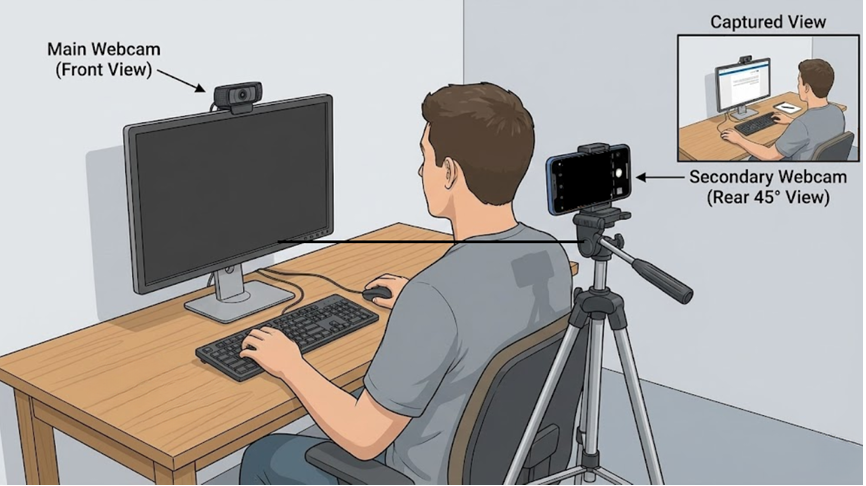
1. Positioning
Place it on a tripod or stable stand.
Angle: 45 degrees behind you (to your side).
View: Camera must see You (Profile) + Your Hands + Your Computer Screen + The Desk.
2. Device Settings (Must Follow)
Airplane Mode: ON (This is critical just in case someone calls your phone).
Wi-Fi: ON (Enable Wi-Fi after turning on Airplane mode).
Do Not Disturb: ON.
Power: Keep it plugged into a charger, or make sure the battery is sufficient for the entire duration of your exam.
How Proctored Exams Work
Exam Formats (3 Options)
Option 1
Remote Home-Based Testing (Online)
Take the exam from your home with remote proctoring.
Option 2
On-Site Computer-Based Test (CBT)
Complete the exam at an authorized testing center.
Option 3
Paper-Based Test
Available only in very limited locations.
Option 1
Remote Home-Based Testing (Online)
Availability
Worldwide during early rollout period
Setup
Take the exam from your home with remote proctoring
Requirements:
1. Computer:
- Windows 8.1 or higher (Mac NOT supported currently)
- Functioning webcam (built-in or external USB)
- Microphone
- Administrative access to install proctoring software
2. Internet Connection:
- Minimum: Stable 10+ Mbps
- Recommended: 20+ Mbps for reliability
- Backup 4G hotspot highly recommended
3. Secondary Device:
- Phone or tablet for additional monitoring angle
- Camera must be functional
4. Testing Environment:
- Private, quiet room with closed door
- Well-lit space (natural or artificial light)
- Clear desk - NO books, notes, or unauthorized materials
- No other people in the room
Not Allowed:
Beverages or food
Books, notes, or any reference materials
Calculators
Scratch paper (whiteboard and marker may be allowed - confirm)
Option 2
On-Site Computer-Based Test (CBT)
Availability
Selected testing centers in major countries
Current Locations:
Advantages:
More reliable (no internet issues)
Controlled environment
Technical support on-site
Process:
Register for CBT option
Arrive 30 minutes early with valid passport
Follow center's security protocols
Complete exam on provided computer
Option 3
Paper-Based Test
Availability
Very limited, specific locations only
Results Delay
14 working days (vs. 7 days for online/CBT)
Exam Day Timeline & Rules
Pre-Exam (30-60 Minutes Before)
1. Clear the Room: No other people, no books, no electronics.
2. Login: You must log in 30–60 mins early.
3. Verification: Complete Facial Recognition and hold your Original Passport to the camera.
4. Environment Scan: You will be asked to pan your camera 360° around the room.
During the Exam
No Leaving: You cannot leave your seat (unless approved for emergency).
Eye Contact: Keep eyes on the screen. Looking away frequently triggers AI flags.
Drafting: Use your whiteboard/transparent sleeve only.
Tech Issues: If internet drops, log back in immediately (answers are auto-saved). If the issue persists, contact the proctor via the software.
Post-Exam
1. Submission: Wait for the "Scroll submitted successfully" message.
2. Erase Notes: Show your whiteboard/sleeve to the camera and ERASE IT before closing the software.
3. Exit: Close the application.
Technical Readiness Checklist
Complete every requirement below before your exam day to avoid technical issues during the CSCA examination.
Computer Requirements
Operating System
Windows 8.1 or higher (Windows 10/11 recommended)
Mac computers NOT currently supported for online testing
Hardware
Processor: Intel Core i3 or equivalent (i5+ recommended)
RAM: Minimum 4GB (8GB recommended)
Storage: At least 2GB free space for exam software
Screen: Minimum 1024x768 resolution (1920x1080 recommended)
Webcam
Built-in or external USB webcam
Minimum 720p resolution
Must be able to show face clearly
For external: 6-foot cord recommended for room scanning
Auto-focus OFF or disabled
Microphone
Built-in or external
Must clearly capture audio
Test with proctor before exam
Software
Latest browser version (Chrome, Firefox, or Edge)
Administrative rights to install proctoring software
Pop-up blockers DISABLED
Antivirus: Add exam URLs to whitelist
No VPN during exam
Internet Requirements
Minimum Specifications:
Download speed: 10 Mbps or higher
Upload speed: 5 Mbps or higher
Latency: Under 100ms preferred
Stability: No frequent disconnections
Test Your Connection:
Visit speedtest.net or fast.com
Run test at planned exam time (same network load)
Run test multiple times over several days
If below minimum, consider:
Upgrading internet plan
Using wired Ethernet connection instead of Wi-Fi
Scheduling exam during off-peak hours
Arranging testing center option
Backup Plan:
4G/5G mobile hotspot ready
SIM with sufficient data (at least 6GB)
Test hotspot connection beforehand
Keep phone charged and nearby (but not in testing room)
Pre-Exam Testing Schedule
2 Weeks Before:
Install exam software (CSCA-designated exam client)
Run official system compatibility check
Test webcam quality on video call with friend
Test microphone clarity
Run internet speed test
Identify any compatibility issues early
1 Week Before:
Complete official mock test (when released)
Practice with secondary device monitoring angle
Do full room scan practice with webcam
Clear testing area completely
Run system check again
Verify firewall/antivirus settings
1-3 Days Before:
Final system check
Verify exam software updated to latest version
Confirm exam language selection
Important Reminders:
Mac OS is not supported
Wireless headphones are strictly prohibited
During the exam, students are required to have a secondary camera for monitoring the side and rear environment (smartphone/tablet is applicable)
Secondary Camera Requirement
During the exam, students are required to have a secondary camera for monitoring the side and rear environment (smartphone/tablet is applicable)
Exam Timezone Conversion Chart
| Region / Timezone | Professional Chinese (1PM Beijing Time) | Math (3:30 PM Beijing Time) | Physics (5:30 PM Beijing Time) | Chemistry (7:30 PM Beijing Time) |
|---|---|---|---|---|
| China, Philippines, Malaysia, Singapore, Brunei (GMT +8) | 1:00 PM – 2:30 PM | 3:30 PM – 4:30 PM | 5:30 PM – 6:30 PM | 7:30 PM – 8:30 PM |
| Thailand, Vietnam, Indonesia (GMT +7) | 12:00 PM – 1:30 PM | 2:30 PM – 3:30 PM | 4:30 PM – 5:30 PM | 6:30 PM – 7:30 PM |
| Kazakhstan (Almaty), Pakistan (GMT +5) | 10:00 AM – 11:30 AM | 12:30 PM – 1:30 PM | 2:30 PM – 3:30 PM | 4:30 PM – 5:30 PM |
| India, Sri Lanka (GMT +5:30) | 10:30 AM – 12:00 PM | 1:00 PM – 2:00 PM | 3:00 PM – 4:00 PM | 5:00 PM – 6:00 PM |
| Moscow, Kenya, Ethiopia (GMT +3) | 8:00 AM – 9:30 AM | 10:30 AM – 11:30 AM | 12:30 PM – 1:30 PM | 2:30 PM – 3:30 PM |
| Germany, France, Nigeria (GMT +1) | 6:00 AM – 7:30 AM | 8:30 AM – 9:30 AM | 10:30 AM – 11:30 AM | 12:30 PM – 1:30 PM |
| UK, Ghana, Portugal (GMT +0) | 5:00 AM – 6:30 AM | 7:30 AM – 8:30 AM | 9:30 AM – 10:30 AM | 11:30 AM – 12:30 PM |
| New York, Toronto (EST) (GMT -5) | 12:00 AM – 1:30 AM (Midnight) | 2:30 AM – 3:30 AM | 4:30 AM – 5:30 AM | 6:30 AM – 7:30 AM |
| Los Angeles, Vancouver (PST) (GMT -8) | 9:00 PM – 10:30 PM (Dec 20 / Prev Night) | 11:30 PM – 12:30 AM (Dec 20 / Prev Night) | 1:30 AM – 2:30 AM | 3:30 AM – 4:30 AM |
CSCA Exam Preparation Checklist
Make sure every item below is ready before your examination day.
Section 1
The Devices & Power
A Windows PC (MANDATORY)
Tripod/Stand
Long Chargers/Power Bank
Ethernet Cable (Recommended)
Backup 4G hotspot
Built-in camera or external USB webcam
Built-in microphone or external wired microphone
Wired headphone/earphone (wireless is prohibited)
Section 2
Drafting Tools (No Paper Allowed)
Transparent Writing Board
Fine-Tip Dry Erase Marker
Eraser/Cloth
Recommended
Link of Recommended Items to Buy:
1. Tripod/Stand
2. Earbuds with built-in microphone
3. Portable wifi
4. USB Webcam
Frequently Asked Questions
All chinese government scholarship (CSC) universities require students to take CSCA exam.
You can check here university admissions pages and 2026 prospectuses:
- Tianjin University (2026 Admissions Guide)
- Nankai University (2026 Admissions Guide)
- Zhejiang University (2026 Admissions Guide)
As of November 2025, these are the universities not yet requiring CSCA for 2026 intake:
- Tsinghua University (but if you wish to apply for a CSC scholarship, you need to take the CSCA exam).
- Beijing Normal-Hong Kong Baptist University (BNBU)
- University of Nottingham Ningbo China (UNNC)
- Xi’an Jiaotong-Liverpool University (XJTLU)
- Sino-British College, USST
- CUHK-Shenzhen
The subjects you must take for the CSCA are determined primarily by your intended major and the language of instruction.
Mathematics is MANDATORY for all applicants, regardless of whether you are pursuing Engineering, Medicine, or Design.
For STEM and Medicine majors, you must take an additional science subject.
Furthermore, if you are applying to any Chinese-taught program, you must include one of the two Specialized Chinese tracks (either STEM Chinese or Humanities Chinese) to demonstrate your academic language proficiency.
The language options depend on the subject. You do not have to take all subjects in the same language.
For the three Basic Disciplines (Mathematics, Physics, and Chemistry), you have a choice to take the exam in either English or Chinese.
This is designed to allow international students to use their strongest academic language for technical subjects.
However, the Professional Chinese subjects (Humanities and STEM Chinese) are offered in Chinese ONLY, as the entire purpose of these tests is to measure your readiness to handle university-level material in the Chinese language.
Students are welcome and encourage all students planning to study in China to take the CSCA exams.
An excellent CSCA score report can be a strong asset in your application to any Chinese university, comprehensively demonstrating your academic abilities.
The official rule states "MacOS is not supported."
Using Boot Camp or Parallels is risky as the anti-cheat software may flag the virtualization as a security threat.
It is strongly recommended to borrow a native Windows laptop.
Yes. Since there are multiple sessions (Jan, March, June, Dec), you can pay to retake it.
However, be careful with application deadlines - a June retake might be too late for a scholarship application closing in March.
No. Once the Admission Ticket is generated, information cannot be changed.
Verify your choices carefully before paying.
There is no limit on the number of times you can retake the CSCA.
As long as you pay the exam fee again, you can register for the next available session.
However, because of application deadlines and the exam schedule, you will realistically only have 1 or 2 chances to get a score that works for a specific September intake.
Yes, you can retake the exam unlimited times, or apply to Chinese universities that don’t require CSCA for 2026 intake.
Scores are valid for two years.
Not for December 2025.
The first global exam is exclusively Home-Based Online (or Computer-Based at select centers).
Paper exams are currently suspended; check the website for future updates.